The Outfit That Works for a Cold Walk and a Warm Restaurant

Quick Answer: Dress for the indoor ninety minutes and add one genuinely warm removable layer for the outdoor eleven. The mistake almost everyone makes is dressing for the walk, which leaves you overheated for the majority of the time. Choose a layer that looks intentional on the back of a chair, and use accessories rather than bulk for the cold part.
The maths is straightforward and almost nobody does it. You will be inside for eight times as long as you are outside.

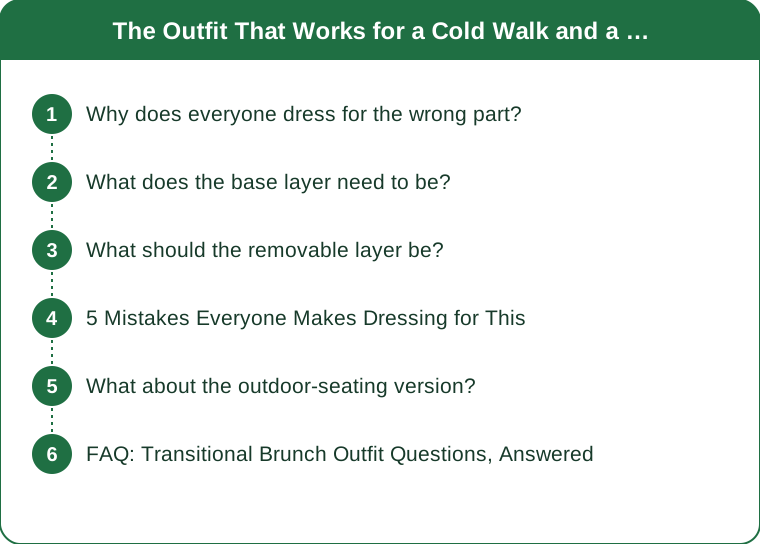
Why does everyone dress for the wrong part?
Because the cold part happens first, and the discomfort is immediate.
You step outside at 10am, it is 52F, and you feel it instantly. So you go back for a heavier coat, a scarf, and a thicker jumper. Ninety minutes later you are in a heated room, sitting near a window in the sun, quietly overheating with a pile of clothing on the back of your chair.
The proportion argument: an eleven-minute walk and a ninety-minute meal is roughly an eight-to-one ratio. Dressing for the eleven minutes optimises the wrong variable by a factor of eight.
Three things make indoor overheating worse than people expect:
- Restaurants run warm - kitchen heat, close seating, and heating systems that get switched on early in the season and set too high
- You warm up when you sit down after walking, and the peak arrives about ten minutes in, right when the food does
- Eating raises body temperature slightly. Hot coffee more so
The correct approach: build the outfit for the indoor temperature, then add one layer that is warm enough for the walk and easy to remove. That layer is the only thing doing seasonal work.
The corollary that matters: the removable layer has to look good removed. It will spend most of the time on the back of a chair, and a good coat on a chair is fine while a technical jacket is not.
What does the base layer need to be?
Something that reads as a complete outfit with no jacket, in a fabric with a little weight.
The specification:
- A single piece or a simple two-piece that looks finished on its own. This is the whole test
- Fabric with some weight - a fine knit, a ribbed cotton, a heavier jersey. Something with structure looks more considered when the coat comes off
- Sleeves that work. A long sleeve you can push up is more versatile than either a short sleeve or a fixed long sleeve, because it gives you a middle setting
- Nothing sleeveless in transitional season. There is always one cold seat by the door and it will be yours
Three combinations that work:
- A fine-knit jumper with straight trousers or jeans. The most reliable. Warm enough for a cool room, not so warm that a heated one is a problem
- A midi dress with boots and opaque tights. Tights are the underrated part - they add real warmth with no visual bulk, and they are why a dress can work at 52F
- A tucked long-sleeve top with a high-waisted trouser. Easy, and the tuck adds definition that survives the coat coming off
What does not work: anything that requires the jacket to look complete. A camisole under a blazer is a summer construction, and taking the blazer off in a warm room leaves you with half an outfit and no option.
Colour, for the record: a base in a deeper tone reads as autumn even if the piece itself is a summer purchase. This is the cheapest seasonal update available.
What should the removable layer be?
Warmer than it looks and structured enough to sit on a chair. Four options, in order of usefulness.
A wool or wool-blend coat, unlined or lightly lined. The best answer for this season. It is genuinely warm for a short walk, it looks better than anything else on the back of a chair, and it does not overheat you the way a padded coat does if you keep it on for the first five minutes.
A trench. Handles rain, looks intentional, and is not very warm on its own - which is exactly right when the base layer is doing the work.
An oversized shirt jacket. The most casual option and the most comfortable to keep on if the restaurant is cool. Also the easiest to push up at the sleeves.
A denim or leather jacket. Works, and it is worth knowing that both are colder than they look. Fine at 55F and marginal below that without a scarf.
What to avoid for this specific situation: a padded or technical puffer. It is the warmest option and the worst one for a restaurant - it takes up a seat, does not drape on a chair, and the temperature range where it is correct is narrower than people think.
The chair test, which is worth doing once: put the layer on the back of a dining chair and look at it. If it slumps into a shapeless pile, it is the wrong layer for a sit-down meal. A structured coat holds its shape; a soft technical jacket does not.
One practical note: if the restaurant is busy, coats often end up on your lap or behind your back. A lighter, thinner layer that packs down is genuinely more practical than a bulky one, which is another argument for warmth coming from the base and the accessories.

5 Mistakes Everyone Makes Dressing for This
1. Optimising for the walk. Eleven minutes out, ninety minutes in. Dress for the ninety.
2. Wearing the heavy jumper as the base. A thick chunky knit is a perfect outdoor layer and a difficult indoor one, because it cannot be removed. If your warmest item is your base layer, you have no adjustment left.
3. Skipping the accessories. A scarf, and gloves if it is genuinely cold, add substantial warmth for the outdoor stretch and take up almost no space indoors. This is the single most efficient way to solve the cold walk without affecting the indoor outfit at all - and it is the thing people leave at home in September because it does not feel like scarf weather yet.
4. Wearing new shoes. You are walking there and back, often on pavement, sometimes further than planned when the first place has a wait. This is not the outing for shoes you have not tested.
5. Forgetting where you will actually sit. The fourth mistake surprises people, but this one determines the whole thing. A patio table with heaters, a seat by the door, and a corner banquette next to a radiator are three completely different temperatures. If you know you are sitting outside, dress for outside and bring the layer you would have taken off.
What about the outdoor-seating version?
Different problem entirely, and worth its own approach in this season.
Patio brunch in autumn is a genuinely cold experience even with heaters, because you are sitting still for ninety minutes rather than walking. Sitting still at 55F is much colder than walking at 48F.
What changes:
- The base layer needs to be warmer. This is the situation for the chunky knit
- Tights or thermal layers under trousers are the difference between comfortable and counting the minutes. Nobody can see them and they do most of the work
- Keep the coat on, and choose one you are happy to sit in for the duration
- Bring the scarf. Neck heat loss while sitting still is significant
- Consider the seat. Metal chairs conduct heat away from you quickly, which is why a patio can feel colder than the air temperature suggests. A coat you can sit on the tail of genuinely helps
On patio heaters: they warm your top half and do very little for your legs and feet, which is where you will get cold. Plan the warmth from the waist down and let the heater handle the rest.
Footwear matters more outside. Standing or sitting on cold ground pulls heat through thin soles. A boot with any thickness of sole is meaningfully warmer than a flat leather shoe, and it is a bigger factor than most people account for.
The honest advice for the last few weekends of patio season: ask when you book, or look at the seating when you arrive. Most of the discomfort in autumn outdoor dining comes from people who dressed for a table they did not end up at.
FAQ: Transitional Brunch Outfit Questions, Answered
What temperature is the cutoff for a light jacket?
Roughly 55F for a short walk if the base layer has weight and you have a scarf. Below 50F you want a proper coat, and below 45F you want it even for eleven minutes.
How do I stop overheating in a warm restaurant?
Push the sleeves up, remove the scarf before you sit, and choose a base in a breathable fibre. Wool and cotton both handle a warm room far better than synthetics.
Are tights worth it under trousers?
Under a dress, absolutely. Under trousers, a thin thermal base layer does the same job and is more comfortable. Both are invisible and both do more than a heavier coat.
What shoes work for a walk plus a sit-down meal?
An ankle boot with a low block heel or a flat with a real sole. The main constraint is that you are walking there and back, which rules out anything you have not already worn for twenty minutes.
TL;DR:
- Eleven minutes outside, ninety inside - dress for the ninety and add one removable layer
- The base has to look complete with no jacket, in a fabric with some weight
- A structured coat beats a puffer, because it looks right on the back of a chair
- Scarf and gloves solve the cold walk without affecting the indoor outfit at all
- Sitting outside is a different problem: warmer base, tights or thermals, keep the coat on
Most brunch discomfort is a proportion error. Optimise the ninety minutes and carry the eleven.
Keep Reading
This article is for general informational and styling purposes only. Fit, sizing, and product availability may vary.