The Brunch Outfit Problem: It Is 24 Outside and 18 Inside

Quick Answer: Build the outfit around a base layer you are comfortable in outdoors and one removable mid-layer with sleeves - a cardigan, an overshirt, or a light knit - rather than one heavy jacket. Sleeves matter more than thickness for indoor cold, because air conditioning tends to hit arms and shoulders first. Choose a fabric with some substance rather than a thin drapey one, since thin fabrics feel cold at 18 degrees regardless of how they look.
You dressed for the walk. You are now sitting directly under a vent, holding a warm coffee for reasons unrelated to wanting coffee, and the conversation has become about how cold it is.

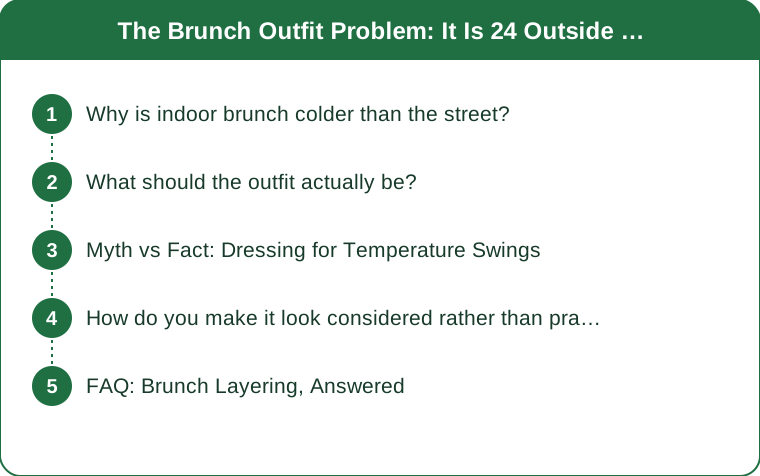
Why is indoor brunch colder than the street?
Air conditioning stays on late in the season. Systems set for summer keep running through the transitional weeks, and restaurants generally run cooler than homes because of kitchen heat, crowd density, and equipment.
Sitting still changes everything. You generate considerably less heat sitting than walking, so the outfit that was correct on a fifteen-minute walk is under-specified after twenty minutes at a table.
Moving air feels far colder than still air. A vent above your table produces a wind-chill effect, which is why one seat can feel dramatically colder than another in the same room.
Bare arms lose heat fast. Arms and shoulders are the areas most exposed to a downward draught, and they are what people notice first.
And the outdoor tables have the opposite problem. Restaurants keep terrace seating open through the warm weeks, so the same booking can be either the coldest or the warmest place in the venue depending on which table you get - which argues for an outfit that handles both.
What should the outfit actually be?
A comfortable base you would happily wear outdoors. A tee, a vest, a light top - the thing you would wear on the walk without a second thought.
One mid-layer with sleeves, chosen for substance. A cotton cardigan, a light knit, or an overshirt. Sleeves are the whole point, and a fabric with some body insulates far better than a thin drapey one of the same apparent weight.
Something for the shoulders as a third option. A scarf, a large light shawl, or a denim jacket that lives on the back of the chair. It handles the vent-directly-overhead scenario without committing you to wearing a jacket indoors.
Full-length or midi bottoms rather than short ones, if the venue is unfamiliar. Legs under a table are less exposed than arms but a cold metal chair on bare legs is its own problem, particularly on a terrace.
Closed shoes over sandals as the season shifts. Feet get cold in air conditioning quickly, and it is the least visible source of discomfort so it goes unaddressed the longest.
And check the bag can carry the layer you remove. Walking home carrying a cardigan is fine; carrying a cardigan, a scarf, and a jacket is the reason people stop layering properly.

Myth vs Fact: Dressing for Temperature Swings
Myth: One warm layer is enough. Fact: one heavy layer is either on or off, and neither state is right for a 6-degree gap. Two lighter layers give you three configurations instead of two.
Myth: Thicker fabric is always warmer. Fact: substance and coverage matter more than thickness at these mild temperatures. A close-knit cotton cardigan frequently outperforms a thicker but loosely woven one.
Myth: You can just ask them to turn it down. Fact: you can ask, and in a busy restaurant it will rarely happen - the system serves the whole room, including a hot kitchen. Asking to move tables is far more likely to work.
Myth: Layering looks bulky. Fact: bulk comes from layering two loose garments. One fitted base under one structured layer reads as intentional and adds almost no visual volume.
Myth: It will not matter, brunch is short. Fact: brunch is frequently the longest sitting meal of anyone’s week - two hours at a table is common, and it is more than long enough for the temperature to become the topic.
How do you make it look considered rather than practical?
Let the mid-layer be the interesting piece. If the cardigan or overshirt is the item with the colour, texture, or pattern, then wearing it looks like the plan rather than a response to the temperature.
Keep the base simple. A plain base means the outfit still works when the layer comes off, which is the actual test of a good transitional outfit.
Repeat one colour across the layers. A shared tone between the base and the mid-layer makes two pieces read as one outfit rather than as an accumulation.
Use the scarf as an accessory rather than as a blanket. Worn loosely from the start, it looks styled. Deployed dramatically at minute forty, it looks like a rescue.
Choose a shoe that carries the season. A loafer or a low boot signals autumn while the afternoons are still warm, and it solves the cold-feet problem at the same time.
And pick a fabric that survives being carried. Linen creases hard when balled into a bag, while cotton knits and jersey recover. This is the difference between a layer you actually bring and one you leave at home after the first time.
FAQ: Brunch Layering, Answered
What should I wear when restaurants are freezing?
A comfortable outdoor base plus one mid-layer with sleeves, and something for your shoulders in reserve. Sleeves matter more than thickness, because air conditioning hits arms and shoulders first.
Why are restaurants so cold in late summer?
Cooling systems are still set for summer, kitchens generate substantial heat that the system compensates for, and sitting still means you generate much less body heat than you did walking there.
How do I layer without looking bulky?
Keep one layer fitted and let the other provide the structure. Bulk comes from stacking two loose garments; a fitted base under a structured cardigan or overshirt adds almost no visual volume.
Should I ask them to turn the air conditioning down?
You can, but a single system serves the whole room and rarely changes for one table. Asking to move away from a vent is far more likely to work, and dressing for it is more reliable than either.
TL;DR:
- Build around an outdoor-comfortable base plus one removable mid-layer with sleeves, not one heavy jacket.
- Sleeves and fabric substance matter more than thickness at a 6-degree indoor-outdoor gap.
- Keep something for the shoulders in reserve, wear closed shoes, and check your bag can carry what you remove.
- Let the mid-layer be the interesting piece so the layering reads as styling rather than as a response.
- Choose fabrics that survive being carried - cotton knits and jersey recover, linen does not.
Moving tables works better than asking them to change the thermostat. Dressing for it works better than both.
Keep Reading
This article is for general informational and styling purposes only. Fit, sizing, and product availability may vary.