What to Wear to Brunch When the Table Is Outside and the Heater Is a Maybe

Quick Answer: Build around three layers with a fourth in your bag: a base you would happily sit in if the sun holds, a mid-layer with sleeves you can push up, and an outer piece that can go over the back of the chair without looking crumpled. The variable people get wrong is not warmth overall - it is that outdoor seating cools your back and legs while your front stays fine. Prioritize covered shoulders, a covered upper back, and full-length legs over a heavier top half.
The patio looked wonderful at 11am. By 12:30 the sun has moved behind the building, the heater above table six is not on, and you are the person at brunch with her arms crossed.
Why do you get cold outdoors even when the forecast says it is mild?
Because the number on the forecast is measured in shade, at a standard height, out of the wind - and none of those describe a cafe patio.
Four things cool you at an outdoor table that do not appear in the forecast:
- You are sitting still. Metabolic heat production drops substantially when you stop moving. The walk over kept you warm; the table will not.
- The chair conducts heat away. Metal and stone seating pulls warmth directly from your legs and lower back. This is why your legs get cold before your arms.
- The sun moves. A table in direct sun at noon can be in full shade forty minutes later, and the difference is worth several degrees of felt temperature.
- Even light wind matters. A gentle breeze on bare arms strips heat far faster than still air at the same temperature.
The practical conclusion: dress for the shaded, seated, breezy version of the forecast, not the sunny walking version. That is usually about five degrees colder than the number you looked at.
What is the layering formula?
Four pieces, and the fourth lives in your bag until it does not.
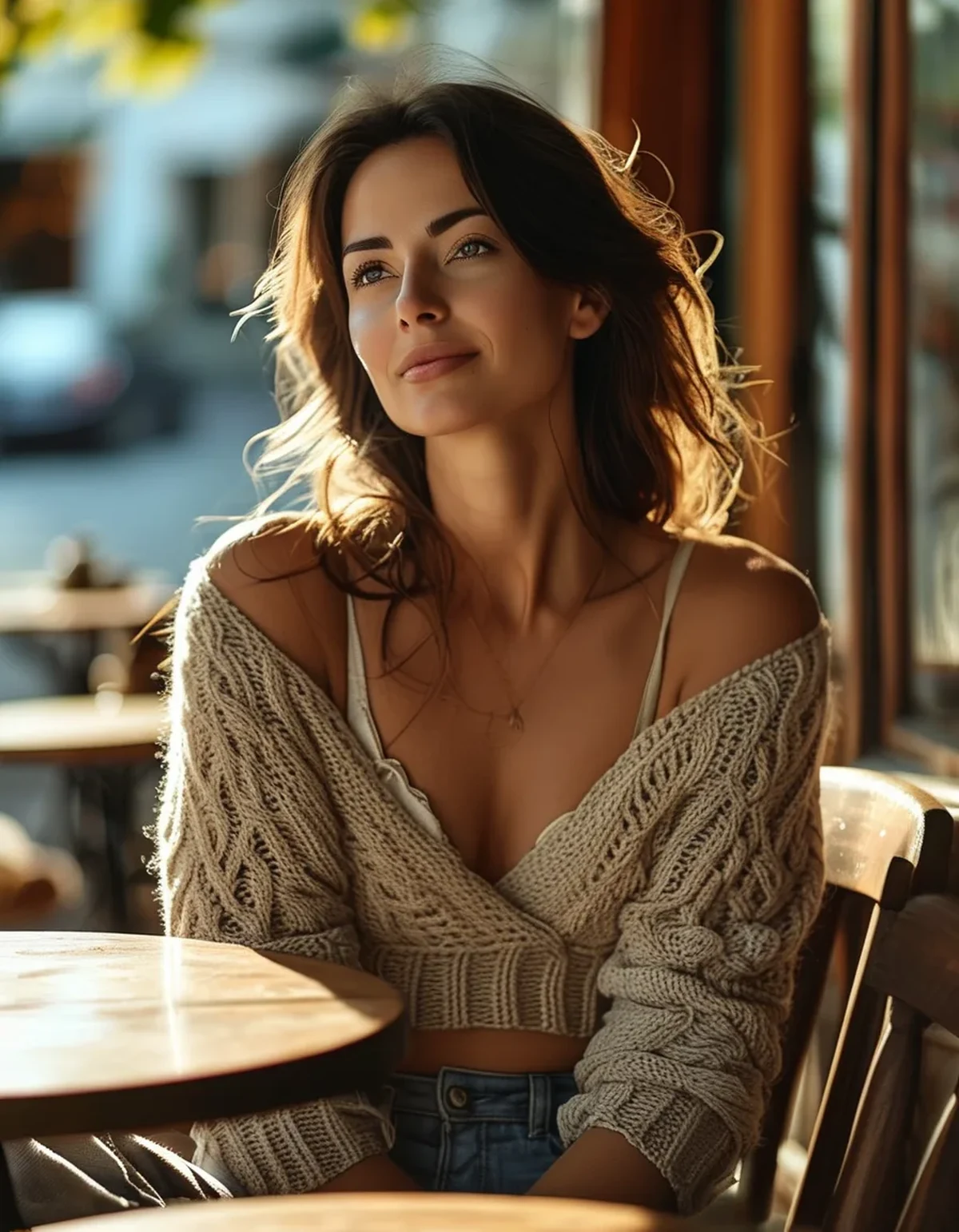
Layer 1 - the base. A fitted long-sleeve or a short-sleeve top you are comfortable in on its own. This is what you wear if the sun holds and the table is warm. Choose fabric with a bit of substance - a fine rib or a slightly heavier jersey holds warmth without bulk.
Layer 2 - the sleeve layer. A light knit, a soft overshirt, or a cardigan. The key property is that the sleeves push up cleanly. You will adjust this piece five times during the meal, and a sleeve that will not stay pushed up becomes a running irritation.
Layer 3 - the shoulder layer. A jacket, a heavier cardigan, or a scarf. This one exists specifically for the back and shoulders - the area that goes cold first when you are seated with your back to open air.
Layer 4 - the bag piece. A packable scarf or a thin wrap. It weighs nothing, it lives in the bag, and it is the difference between staying for a second coffee and leaving.
On the bottom half: full-length rather than cropped. Bare ankles at a shaded outdoor table are the single most common regret, and long trousers or leggings with a closed shoe cost you nothing if the sun does come out.
What Nobody Tells You About Dressing for Outdoor Tables
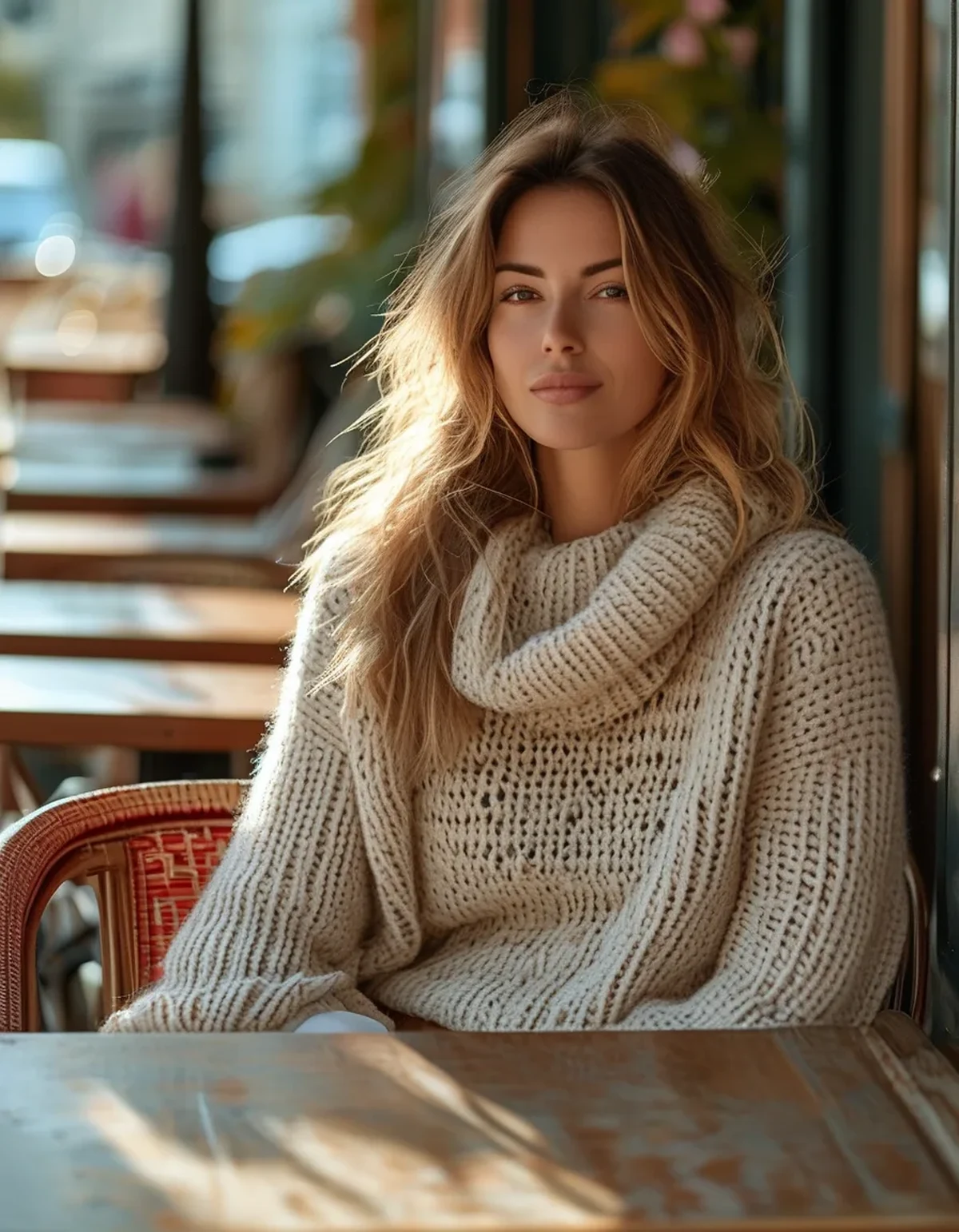
Your back is the problem, not your front. Facing into a restaurant or a heater keeps your front comfortable while your back radiates heat into open air. This is why people at outdoor tables reach for something to put over their shoulders rather than something to zip up. A wrap or scarf across the upper back does more than a heavier top.
Chairs decide your trousers. Metal, wicker, and stone all conduct. A rattan or padded chair is neutral. You cannot know in advance, which is a solid argument for full-length legs by default.
A jacket over a chair back gets creased and cold. If you take a layer off, drape it over your own shoulders or across your lap rather than hanging it behind you - it stays warm and it stays presentable.
Patio heaters heat a small cone. They warm your head and shoulders directly beneath and do almost nothing at chest height two seats away. Being at a heated table is not the same as being warm.
Shoes matter more than expected. Cold comes up through paving. A closed shoe with an actual sole outperforms a heavier top layer for overall comfort, and nobody thinks to check it.
Sunglasses are still relevant. Low, late-summer sun sits directly in your eyes at an outdoor table in a way midsummer sun does not. The sun is lower now, not weaker.
How do you keep it from looking like you dressed for a hike?
The risk with layering is bulk, and bulk is what turns a considered outfit into a functional one.
Keep the layers thin and the count high. Three thin layers are warmer and slimmer than one thick one, and they give you options a single jumper does not.
Vary the texture, hold the palette. A rib base, a smooth knit, and a structured jacket in two or three related colours reads as intentional. Three similar textures in three unrelated colours reads as whatever was clean.
Let the outer layer be the structured one. Something with a shoulder line - a light jacket, an unstructured blazer, a denim layer - pulls the whole outfit up. Three soft layers together read as loungewear.
Length hierarchy matters. Base shortest, mid layer slightly longer, outer longest, or all three roughly level. A base layer hanging below the mid layer is the detail that makes layering look accidental.
One defined line somewhere. A tucked base, a belt, or a fitted trouser gives the eye a shape to read. Layers without one point of definition become a column.
The fastest version, if you want a formula: fitted long-sleeve, cropped or hip-length knit, full-length trouser, structured jacket, scarf in the bag. It handles roughly ten degrees of variation and looks like you got dressed on purpose.
FAQ: Outdoor Brunch Outfit Questions, Answered
Should I bring a blanket scarf or a proper jacket?
A large scarf is more versatile at a table because it works across the shoulders, over the lap, or around the neck, and it packs down. A jacket wins if you have any distance to walk, or if wind is in the forecast - scarves and wind do not cooperate.
What if the restaurant offers blankets?
Many places do now, and they are genuinely warm. But plan as though they will not be available, because they run out, and a blanket over bare legs is far less comfortable than trousers plus a blanket.
Are cropped trousers ever fine for this?
With a boot or a closed shoe and a sock, yes. Cropped with a bare ankle and a sandal is the combination people regret. The ankle is a genuinely significant heat-loss point when you are seated and still.
How do I dress if we are walking somewhere after?
Dress for the table, not the walk - you will be warmer moving. Bring the layer you would need seated and carry it while walking. The reverse approach, dressing for the walk, leaves you cold for the entire ninety minutes you are stationary.
TL;DR:
- Dress for the shaded, seated, breezy version of the forecast - roughly five degrees colder than the number you saw.
- Four layers: a base you would sit in happily, a push-up-sleeve mid layer, a shoulder layer, and something packable in the bag.
- Your back and legs go cold first, not your arms. Prioritize a covered upper back and full-length legs.
- Three thin layers beat one thick one - warmer, slimmer, and adjustable as the sun moves.
- Closed shoes with a real sole do more than a heavier top. Cold comes up through the paving.
Outdoor tables are the best part of this stretch of the year and the least predictable. Build the outfit around what happens after the sun moves, and you get to stay for the second coffee.
Keep Reading
This article is for general informational and styling purposes only. Fit, sizing, and product availability may vary.